


Tasting notes
Bright and citric
-
Cherry

-
Green Apple

-
Sour Candy

As seen in


Three quick questions and we'll match you with an Irving Farm coffee, blends and single origins. 15% off your first order.
Question 1 of 3
Question 2 of 3
Question 3 of 3
Last step
Drop your email and we'll send your match plus your code, so it's waiting when you are.
Your match
Tasting notes
15% off your first order
Check your inbox. Your own 15% code is on its way.
One use, for your first order.
Tasting notes
Bright and citric
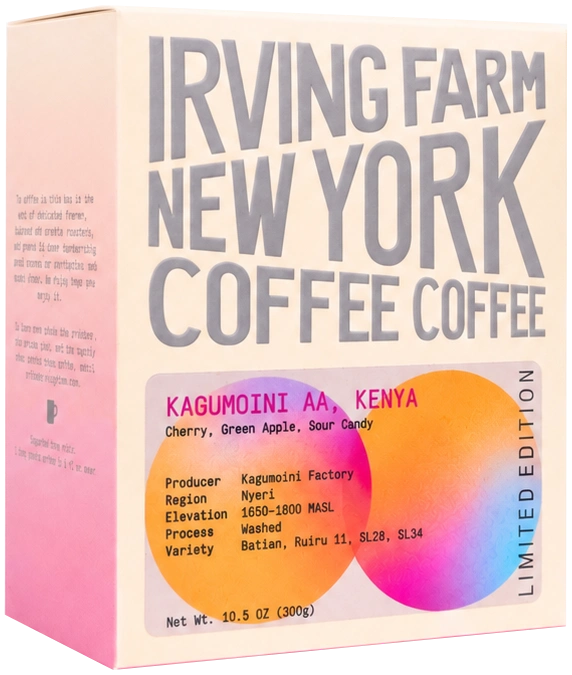
Nyeri, Kenya · 1650-1800 MASL · Washed
Limited Edition Series
Nyeri Kenya sits in the country’s Central Highlands, around 150 miles north of Nairobi and just 20km from Mount Kenya National Park. Unlike its neighbor, Ethiopia, where coffee evolved and grows naturally, coffee was brought to Kenya by French missionaries in the late 19th century. Under English colonial rule, coffee was cultivated on large estates and exported as a cash crop. Since Kenya gained independence in 1963, the production model has changed, with 75% of coffee production in Kenya coming from small producers who are farming less than 5 acres.
Most smallholders in Kenya sell their coffee to a local washing station, which in Kenya are called “Factories”. These washing stations buy cherry and process it into finished lots. In Kenya, as coffees are washed after fermentation, they are sorted by size in long grading channels. As the coffee and water wind through the grading channel the coffee settles out by size. AA is the designation for the largest size of coffee in Kenya’s classification system. Kenya’s washing stations are known for meticulous washing, leading to exceptional quality. Kenya’s washed coffees have long been considered among the best in the world, and the best lots are highly sought after.
The taste profile of Kenyan coffees is distinct from other countries in East Africa. The unique and exceptional qualities of Kenyan coffee come from the unique terroir in Kenya, the meticulous processing, and unique coffee varieties that are cultivated in Kenya. This coffee is predominantly 4 different varieties from Kenya. SL28 and SL34 are both varieties that were developed by Scott Agricultural Laboratories in the 1930s. Scott Labs was an agricultural research organization in Kenya, and these highly successful varieties are still widely cultivated in Kenya and abroad. Ruiru 11 is a hybrid variety that crosses varieties with Catimor (an arabica variety with some Robusta genetics that is the parent or grandparent of many modern hybrids) resulting in a more productive and disease resistant variety. Finally, Batian was developed in 2010 by Kenya’s Coffee Research Institute. The only way to truly understand what makes Kenyan coffee so exceptional is to taste it yourself! We hope you enjoy this bright, exciting expression of coffee from Kenya.


Kagumoini Factory, Nyeri, Kenya
Kagumoini Factory
01
Smallholder farmers in the Nyeri region bring their cherry to the Kagumoini Factory, their local washing station.
02
The coffee is carefully fermented for 12-24 hours.
03
It is washed and sorted by size in long grading channels. As the coffee and water wind through the channel, the coffee settles out by size.
04
AA is the largest size of coffee in the Kenyan coffee grading system.


Kagumoini Factory
KAGUMOINI AA, KENYA
LIMITED EDITION
The Limited Edition Series, created in honor of Irving Farm’s 30th anniversary, highlight exceptional coffees, the people and partnerships behind them, and the sustainable practices and innovative approaches that continue to shape the future of coffee.
Cherry, Green Apple, Sour Candy
Nyeri, Kenya
1650-1800
Meters above sea level, where it grows in Nyeri
AA
The largest size of coffee in the Kenyan grading system
12-24
Hours of fermentation before it is washed
75%
Of Kenya’s coffee comes from small producers farming less than 5 acres
20km
From Mount Kenya National Park
1930s
When Scott Agricultural Laboratories developed SL28 and SL34


Nyeri, Kenya
